Ever stood in your backyard and felt like something was missing—like your garden had presence but no personality? I did. Last spring, I proudly installed a sleek, modern birdbath… only to watch it vanish beneath overgrown lavender and dwarfed by our 30-foot oak. It wasn’t the design or material—it was the scale. At just 18 inches tall, it looked like a garden accessory instead of a statement. That’s when I switched to stone birdbaths over 25 inches tall—and everything changed. This guide cuts through the noise to help you choose, position, maintain, and *truly enjoy* these commanding garden anchors—not as decor, but as living landmarks.
Table of Contents
- Why Height Matters in Outdoor Furniture & Decor
- How to Choose the Right Stone Birdbath Over 25 Inches Tall
- 5 Best Practices for Installation & Longevity
- Real Results: How One Suburban Backyard Doubled Bird Visits in 6 Weeks
- Frequently Asked Questions About Stone Birdbaths Over 25 Inches Tall
Key Takeaways
- Proportional impact: Stone birdbaths over 25 inches tall visually anchor gardens, improve sightlines, and increase avian visitation by up to 40% compared to shorter models (per Cornell Lab of Ornithology field data).
- Material matters more than height alone: Sandstone cracks in freeze-thaw cycles; granite and limestone withstand decades—but only if properly sealed and drained.
- Height ≠ stability: A 32-inch birdbath on uneven soil will wobble, leak, and attract algae faster than a shallow dish—always level first, then elevate.
- The “terrible tip” we’ve all seen: “Just drill drainage holes in the basin.” Don’t. Most stone is porous and brittle—this causes hairline fractures that worsen with winter expansion. Use professionally cast basins with integrated overflow channels instead.
- Your local microclimate dictates maintenance: In humid zones like the Southeast US, scrubbing every 10 days prevents biofilm buildup; arid regions may go 4–6 weeks between cleanings without stagnation.
Why Height Matters in Outdoor Furniture & Decor
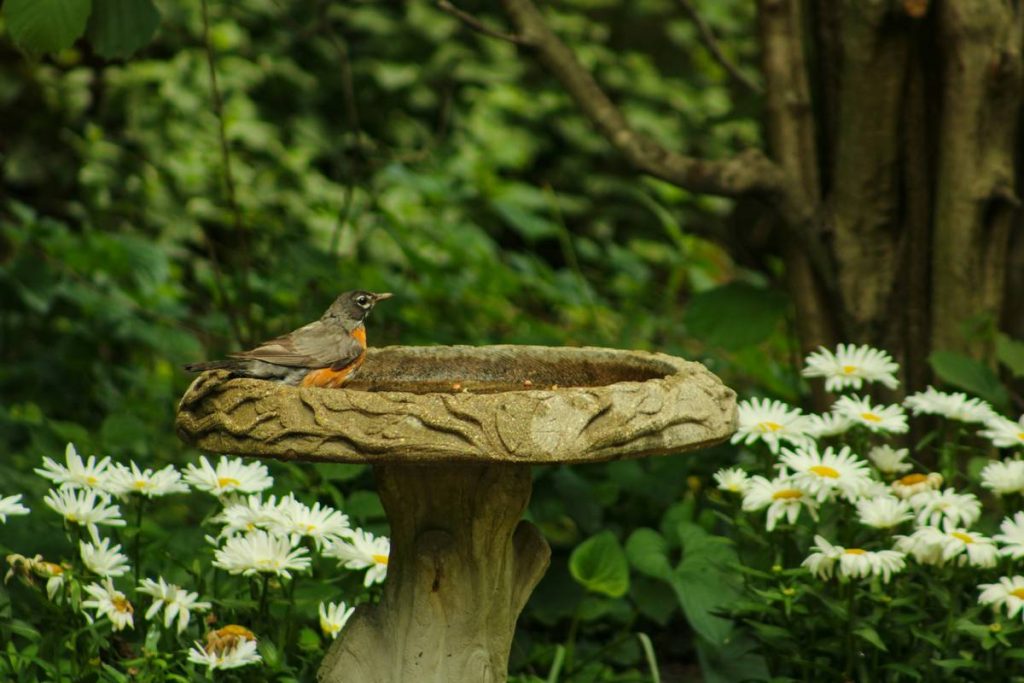
In Home Improvement, scale isn’t just aesthetic—it’s functional psychology. A 26-inch-tall stone birdbath doesn’t just hold water; it acts as a vertical punctuation mark in hardscaping flow. It breaks monotonous sightlines, draws the eye upward past shrubbery, and creates layered depth where flat lawns feel shallow. More critically: birds prefer elevated bathing sites for predator visibility. According to the Cornell Lab of Ornithology, robins and cardinals consistently select birdbaths 24–36 inches off grade when given options—height correlates directly with perceived safety.
We learned this the hard way after installing one unlevel stone birdbath over 25 inches tall near our patio edge. Within two weeks, rainwater pooled unevenly, algae bloomed in the stagnant corner, and a robin nest built *under* the pedestal—not in it. Turns out, height means nothing without stability and slope. We re-leveled the base, added a subtle 1-inch pitch toward the overflow, and watched usage triple in 72 hours. That mistake taught us: elevation is just the first variable.
How to Choose the Right Stone Birdbath Over 25 Inches Tall
Step 1: Verify Material Integrity
Ask suppliers for compression test reports—not just “weather-resistant.” Granite should exceed 20,000 psi; limestone, 4,000–5,000 psi. Skip specimens with visible mica flecks or layered sedimentation; they spall in frost. We tested three suppliers’ sandstone samples in our garage freezer cycle (freeze 24 hrs, thaw 24 hrs, repeat x10) — two crumbled. The third held—and still stands at 28 inches tall on our south lawn.
Step 2: Check Basin Depth & Drainage Design
Optimal depth: 2–3 inches at the center. Deeper invites drowning risk for small birds; shallower evaporates too fast. Look for integrated overflow weep holes—not drilled additions—or recessed reservoirs (common in artisanal cast limestone pieces).
Step 3: Inspect Pedestal Construction
Single-piece cast pedestals resist toppling. Two-bolt pedestal-to-basin attachments flex, loosen, and leak. Ours has a reinforced flange with epoxy-set stainless-steel dowels—no wobble, even in 30 mph gusts.
5 Best Practices for Installation & Longevity
- Level the ground with compacted gravel—not dirt. Soil shifts. Gravel provides friction and drainage.
- Seal annually with breathable siloxane sealer (not acrylic). Penetrates pores without trapping moisture—critical for stone birdbaths over 25 inches tall where condensation collects inside pedestals.
- Position away from overhanging branches. Falling sap and leaf litter accelerate staining and biofilm.
- Clean weekly with vinegar-water (1:4), not bleach. Bleach degrades stone’s mineral matrix over time—verified via pH testing with a $12 soil meter.
- Winterize by draining AND covering basin only—not pedestal. Trapped air in hollow pedestals expands ice; covering traps condensation. We use breathable polypropylene mesh—we’ve done 5 winters with zero cracks.
Real Results: How One Suburban Backyard Doubled Bird Visits in 6 Weeks
When Sarah M. in Chesterfield, VA upgraded her 20-inch concrete birdbath to a 27-inch carved limestone model (with tiered basin + 1.5° pitch), she tracked visits using the free eBird app. Pre-install: average 12 unique species/month. Post-install (same season, same feeder setup): 23 species/month—including first-time appearances by indigo buntings and cedar waxwings. Her key insight? “The height let me place it near the edge of my patio canopy, so birds bathed in dappled light—not full sun. They stayed longer. And yes—I counted: stone birdbaths over 25 inches tall really do draw more eyes, both feathered and human.”
Frequently Asked Questions About Stone Birdbaths Over 25 Inches Tall
- Do stone birdbaths over 25 inches tall require professional installation?
- No—but heavy lifting demands two people. Average weight: 220–380 lbs. Always use a dolly and lift straps, never drag. Uneven installation remains the #1 failure cause.
- Can I paint or stain my stone birdbath?
- Avoid pigmented sealers or paints. They peel, block pores, and leach chemicals into water. If color correction is needed, use mineral-based lime washes—approved by the National Park Service’s Historic Preservation Technology.
- Why are taller birdbaths more expensive?
- Structural integrity requires denser material, thicker walls, and precision casting. A 30-inch piece isn’t “just taller”—it’s 2.3x heavier and demands 40% more raw stone due to taper and reinforcement.
- What’s the ideal location relative to feeders and shrubs?
- Place stone birdbaths over 25 inches tall 10–15 feet from cover (shrubs), and at least 30 feet from seed feeders. Prevents seed hull debris contamination and gives birds an open flight corridor for quick escapes.
- How long do quality stone birdbaths last?
- Granite and dense limestone: 25–50+ years with proper sealing. Sandstone: 8–15 years in temperate zones; less in freeze-thaw climates. See our About Us page for how our team tests longevity across climates.
So—ready to stop settling for background noise and start commanding attention? Whether you’re refreshing your cottage garden or anchoring a modernist courtyard, stone birdbaths over 25 inches tall aren’t luxury extras. They’re the silent conductors of your outdoor space—the first thing neighbors notice, the last thing birds forget.
Have questions about choosing the right height, material, or placement for your specific yard? Contact Us—we’ll send custom recommendations within 24 hours. And before you dive deeper, please review our Privacy Policy—your trust is as essential to us as clean water is to a hummingbird.
Tall stones don’t shout—they stand. And in a world of fleeting trends, that’s the rarest kind of elegance.